Multi Train Controller (Sony PlayStation 2)
Overview
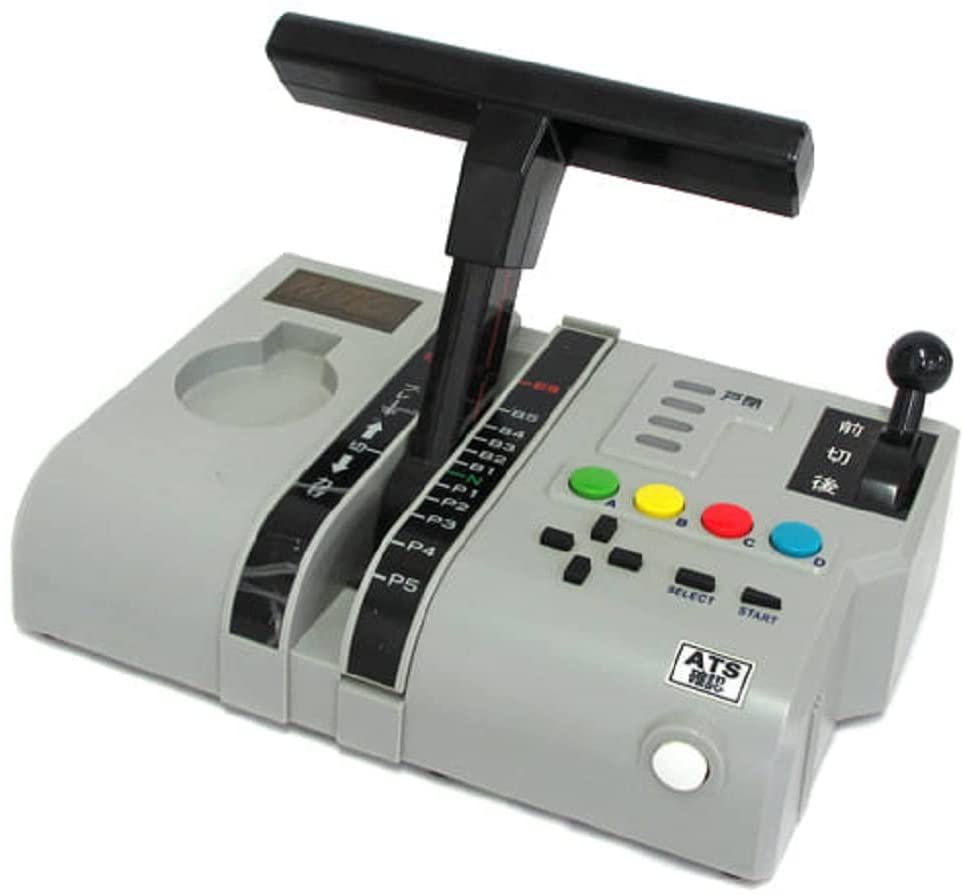 | Name | Multi Train Controller (Sony PlayStation 2) |
| Release date | December 18, 2003 | |
| Serial code | SOTP-031201 | |
| Notes | Released with 4 cartridges: P4-B7, P4-B7 (without B1), P5-B5 and P5-B8. Additional cartridges sold separately: P5-B7 and P13-B7. |
Supported software
Technical details
This controller has one handle with several notch cartridges (P4/B7, P4/B2-B7, P5/B5, P5/B7, B5/B8, P13/B7), a D-Pad and 7 buttons (Select, Start, A, B, C, D, ATS). The A button can distinguish between “soft” and “hard” presses. In addition, the controller has four lamps.
Internally, it is a vendor-specific class device. The input data is compatible with HID, but the device does not provide a HID descriptor. The USB descriptors and the reported data change depending on the notch cartridge inserted.
| Product name | None |
| Manufacturer | None |
| Vendor ID | 0x0AE4 0x1C06 (P5/B5) |
| Product ID | 0x0101 0x77A7 (P5/B5) 0x0004 (P5/B8) |
| Serial number | None |
| USB standard descriptor | P4/B7 P4/B7 (without B1) P5/B5 P5/B7 P5/B8 P13/B7 |
| HID report descriptor | P4/B7, P4/B2-B7, P5/B7, P13/B7 (recreated, not provided by actual device) |
P5/B5 cartridge
When this cartridge is inserted, the controller emulates the Train Mascon. The buttons are mapped 1:1 except the D button, which is mapped to the Close (閉) button.
The lamps are used as follows, from top to bottom: doors, ATS, 45 and 15.
P5/B8 cartridge
When this cartridge is inserted, the controller emulates the Two handle controller “Type 2”. The buttons are mapped 1:1 and ATS is mapped to START. The reverser is mapped to the D-pad UP and DOWN buttons.
Only the top lamp is used, for the doors.
P4/B7, P4/B2-B7, P5/B7, P13/B7 cartridges
When any of these cartridges is inserted, the controller functions similarly to the P5/B5 mode and data changes depending on the amount of notches. The specific cartridge in use can be detected by looking at the bcdDevice value from the standard USB descriptor:
| Cartridge | bcdDevice |
|---|---|
| P4/B7 | 0x0300 |
| P4/B2-B7 | 0x0400 |
| P5/B7 | 0x0800 |
| P13/B7 | 0x0A00 |
Input
The controller sends reports to the host (PS2) formed by 4 bytes:
| Byte # | Data |
|---|---|
| 1 | 0x01 (fixed) |
| 2 | Reverser+handle |
| 3 | Buttons 1 |
| 4 | Buttons 2 |
The reverser+handle byte combines two values representing the state of the reverser and the power/brake handle. The handle notch is represented sequentially starting from 0x1 (Emergency), brake notches from highest to lowest, N and power notches from lowest to highest.
| Position | Value |
|---|---|
| Forward | 0x8X |
| Neutral | 0x0X |
| Backward | 0x4X |
Note
The P5/B7 and P13/B7 cartridges do not make use of the reverser and use both nibbles for the handle notch.
The first button byte uses bits to represent the state of the physical buttons. 0 means that the button is released and 1 that it is pressed.
| Bit | Physical Button |
|---|---|
| 1 | ATS |
| 2 | D |
| 3 | A (soft) |
| 4 | A (hard) |
| 5 | B |
| 6 | C |
| 7 | Unused |
| 8 | Unused |
The second button byte also uses bits to represent the state of the physical buttons.
| Bit | Physical Button |
|---|---|
| 1 | Start |
| 2 | Select |
| 3 | Up |
| 4 | Down |
| 5 | Left |
| 6 | Right |
| 7 | Unused |
| 8 | Unused |
Output
The controller supports receiving data via a control transfer to turn on/off the lamps. The setup packet is as follows:
| Data | Value |
|---|---|
| bmRequestType | 0x40 |
| bRequest | 0x50 |
| wValue | Lamp data |
| wIndex | 0x0 |
| wLength | 0x0 |
Changing wValue controls the lamps with the logic below.
- Door lamp: 0x0X is Off, 0x1X is On.
- Signal lamp: 0xX0 is Off, 0xX1 is ATS, 0xX2 is 45, 0xX3 is 15.